Learning Struggles
The 5 Types of Struggling Learners
Most schools see these students and assume ADHD, anxiety, motivation, or behavior. What they are often seeing are different ways the nervous system compensates for missing developmental foundations.
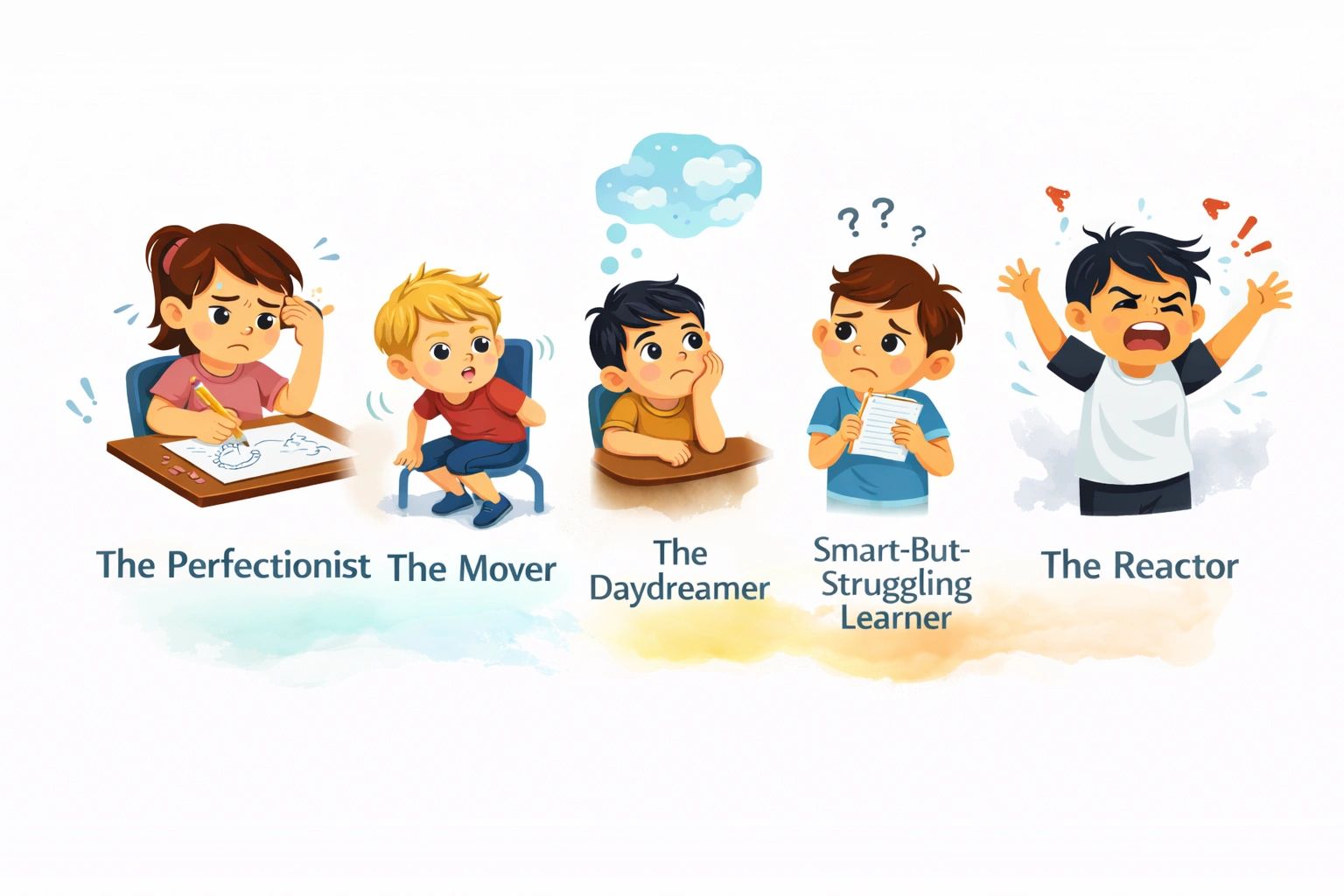
Perfectionist / Anxious Learner
What You See
- •Erases repeatedly or restarts work over and over
- •Gets stuck on small mistakes
- •Takes much longer than peers to complete work
- •Avoids beginning tasks they might fail
- •Melts down when corrected
- •Becomes anxious during tests or timed work
- •Asks constant reassurance questions ("Is this right?")
What Is Happening Neurologically
- •Over-reliance on parvocellular (detail) processing
- •Reduced peripheral awareness — system feels unsafe
- •Attention becomes narrow and rigid
- •Emotional system activates easily
Teachers often say: "They are very capable but take forever."
Fidgety / Sensory-Seeking Learner
What You See
- •Constant fidgeting
- •Rocks in chair or leans on desk
- •Falls out of chair or sits in unusual positions
- •Taps pencils, feet, or fingers
- •Chews on clothing or objects
- •Seeks pressure or crashes into things
- •Appears hyperactive
What Is Happening Neurologically
- •Weak proprioceptive and vestibular input
- •Nervous system seeking information to regulate
- •Possible retained reflexes (often Spinal Galant or STNR)
- •Body movement is being used to stabilize attention
Teachers often say: "If they could just sit still, they'd be fine."
Disengaged / Spacey Learner
What You See
- •Stares off into space
- •Misses instructions
- •Works slowly
- •Appears disengaged
- •Needs directions repeated
- •Often the last to start assignments
- •Seems quiet and compliant but falls behind
What Is Happening Neurologically
- •Under-activated attention system
- •Weak magnocellular spatial orientation
- •Reduced sensory engagement with the environment
- •Brain protecting itself from overload by disengaging
Teachers often say: "They're sweet, but they're always somewhere else."
Bright-But-Inconsistent Learner
What You See
- •Verbally bright
- •Participates in discussion
- •Poor written output
- •Struggles to organize thoughts on paper
- •Knows answers but freezes during tests
- •Work quality inconsistent
- •Appears capable but underperforms
What Is Happening Neurologically
- •Weak functional imagery (eidetic capacity)
- •Difficulty holding mental representations
- •Ocular motor inefficiencies may interfere with reading and writing
- •Cognitive ideas cannot stabilize internally
Teachers often say: "They're so smart — I don't understand why their grades are low."
Reactive / Emotionally-Volatile Learner
What You See
- •Emotional outbursts
- •Sudden frustration
- •Difficulty transitioning between tasks
- •Overreacts to corrections
- •May shut down or become oppositional
- •Stress tolerance is low
- •Behavior worsens during academic tasks
What Is Happening Neurologically
- •Nervous system stuck in survival mode
- •Retained Moro reflex often involved
- •Reduced peripheral awareness
- •Amygdala activates quickly under stress
Teachers often say: "They go from zero to sixty."
What Schools Often Miss
Most schools see these students and assume ADHD, anxiety, motivation problems, or behavior issues. But what they are often seeing are different ways the nervous system compensates for missing developmental foundations.